
ECACC: Cancer cell lines in action
 The European Collection of Authenticated Cell Cultures (ECACC) supplies over 500 cancer cell lines for research, spanning carcinoma, lymphoma, sarcoma and leukaemia. These models represent a wide range of species, including human and rodent, and tissue types such as breast, colorectal, oesophageal, ovarian and bladder.
All ECACC cancer cell lines undergo rigorous quality control, giving researchers confidence in their use. Authentication is conducted in line with the ANSI/ATCC ASN-0002-2021 standard. Microbial testing, including for Mycoplasma contamination, is performed using methods accredited to ISO/IEC 17025:2017, ensuring reproducibility and reliability. Certificates of analysis are available for all lines, and expert technical support is provided to promote best practice in cell culture.
ECACC offers cancer cell lines derived from a broad range of organs and systems, including the central nervous, endocrine, gastrointestinal, urinary and reproductive systems, as well as tissues such as skin, muscle, bone and breast. The use of authenticated cell lines such as these supports robust science, helping to secure research funding and enabling publication in high-quality journals. ECACC cancer cell lines are widely used across basic research, drug discovery, biomarker identification, immuno-oncology, bridging the gap between molecular biology and clinical translation.
Established ECACC Cell Line Models
Oesophageal cancer cell lines
ECACC provides a series of oesophageal adenocarcinoma (EAC) cell lines validated through international efforts to confirm authenticity (Boonstra et al., 2010)1. This work demonstrated that commonly used lines SEG-1 and SK-GT-5 were misidentified, while confirming that FLO-1, KYAE-1, SK-GT-4, OE19, OE33, OACP4C, OACM5.1, ESO26 and ESO51 are genuine EAC models. These validated lines, with accompanying genotyping data, are available from ECACC.
Colorectal cancer cell lines
Colorectal cancer is one of the most common cancers worldwide. ECACC provides over 60 colorectal cancer cell lines representing diverse stages and levels of differentiation.
Among these is HCA-7 Colony 29, a COX-2-expressing human colon cancer cell line. It forms polarised epithelial sheets, enabling the study of biomolecule trafficking and epithelial organisation2. As COX-2 overexpression is linked to colorectal cancer progression, this model is particularly useful for investigating inflammation-associated tumour biology and therapeutic targeting.
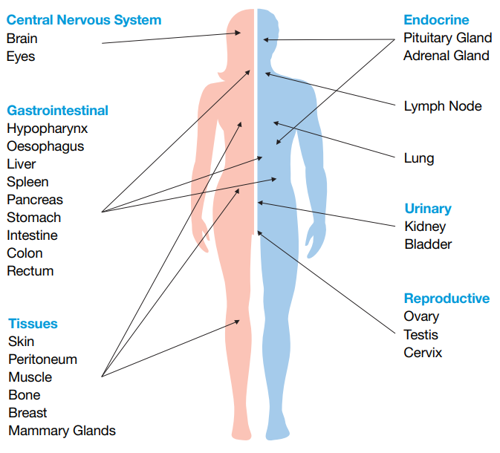
Cancer cell lines available from an extensive range of organs and tissues.
Cell line profiles in practice
ECACC cell line profiles are comprehensive, standardised data sheets designed to support reproducibility and informed model selection. Key cancer related examples include:
-
A549 (86012804): Derived from a lung adenocarcinoma, this cell line closely resembles alveolar type II pneumocytes and is widely used in lung cancer biology, toxicology and drug response studies.
-
Bob (10021102): The first spontaneously immortalised prostate cancer cell lines from castration-resistant prostate cancer, providing valuable models for advanced disease research.
-
MDA-MB-231 (92020424): A highly aggressive triple-negative breast cancer model, extensively used for studying invasion, metastasis and therapeutic development.
-
OE19: An oesophageal adenocarcinoma model used in carcinogenesis and drug response studies, including targeted therapies such as lapatinib.
-
PANC-1: A pancreatic cancer cell line used to model pancreatic ductal adenocarcinoma and evaluate targeted treatments.
A full list of profiles is available on the Culture Collections website: ECACC cell line profiles
Lesser-Known ECACC Cancer Cell Lines
ECACC also offers unique and underutilised models with important research applications:
-
HOS (87070202): An osteogenic sarcoma cell line used to study bone cancer progression, drug resistance and viral interactions.
-
SCC-4 (89062002): Derived from tongue squamous cell carcinoma, widely used in studies of oral cancer progression and responses to chemotherapy.
-
CHP-134 (06122002): A neuroblastoma cell line with N-myc amplification, making it valuable for high-risk paediatric cancer research and studies of oncogene regulation.
-
DLRP (20082610): A metastatic lung squamous cell carcinoma model with extensive chromosomal abnormalities, suitable for drug resistance and genomic studies.
-
Karpas 707 (22110801): A multiple myeloma cell line useful for investigating chromosomal abnormalities, including the Philadelphia chromosome, and bone disease mechanisms.
Looking Forward
Cancer cell lines remain a central focus for ECACC in 2026, with an active acquisition programme continuing to expand the collection and strengthen support for the scientific community.
Our upcoming pipeline features a range of innovative additions, including ovarian cancer cell lines paired with fallopian tube samples from the same patient, representing our first set of non-diseased ‘normal’ pairings. We are also introducing breast cancer cell lines expressing Breast Cancer Resistance Protein (BCRP), alongside squamous cell carcinoma models resistant to mitoxantrone and taxotere. In addition, the collection will be broadened with diverse pelvic, bladder, and urinary tract cell lines spanning multiple cancer grades and stages.
Together, these developments reflect ECACC’s ongoing commitment to providing high-quality, relevant models that advance cancer research and therapeutic discovery.
To keep up to date with new cell lines added to the collection, browse our new cell lines.
References
-
Boonstra et al., (2010) Verification and Unmasking of Widely Used Human Esophageal Adenocarcinoma Cell Lines. J Natl Cancer Inst. Feb 24;102(4):271-4. PMCIM:PMC2902814.
-
Mann et al. (2001) Gasteroenterology 120 1713-1719, Coffey et al. (1997) PNAS 94 657-662, Marsh et al. (1993) J. Pathology 170 441-450, Kirkland (1985) Cancer Research 58 323-2327