
Cell Line Profile A549
(ECACC Catalogue no. 86012804)
Cell line history
The A549 cell line was isolated in 1973 from a pulmonary adenocarcinoma1 in a study aiming to establish continuous cell lines from 200 different tumors. Initially developed for cancer research, the cell line was later characterized as representative of Alveolar Type II pneumocytes of the human lung2,3,4,5, making it a cornerstone of respiratory research for nearly four decades. Early passage A549 studies, conducted shortly after its isolation, demonstrated its ability to exhibit features of the ATII epithelial cell phenotype3,4,5. Reports also indicated that extended culture of early passage material led to cellular 'differentiation,' evidenced by the expression of high numbers of Multilamellar bodies (MLB)2,6, suggesting potential surfactant production, a key characteristic of ATII cells. However, more recent studies7,8 have adopted a more cautious perspective on the cell line's ability to fully recapitulate the ATII phenotype. Recent work9 has shown that extended culture in physiologically relevant cell culture medium may enhance the ATII-like properties of the cell line.
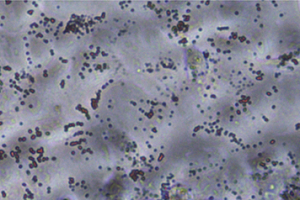
A459 monolayer stained for lipid droplets using Oil-Red O
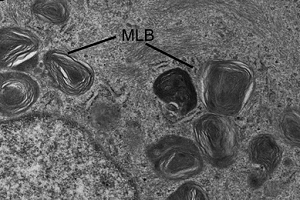
Transmission Electron Micrograph (TEM) of Multilamellar bodies (MLB) in an A549 cell after long term culture (n=nucleus).
Key characteristics
Using the cytidine diphosphocholine pathway the cells can synthesise phospholipids (lecithins) which manifest as lipid droplets in the cytoplasm. With long term culture in a physiological medium the lipid may be expressed as Multilamellar Bodies (MLB) similar to those seen in ATII pneumocytes. Extensive RNA microarray analysis of the gene expression of the cell line is openly available.
Applications
Cancer research, the generation of epithelial models of the distal lung for studies into airway function and disease and virology; the A549 cell line is a suitable host for many human respiratory viruses including adenoviruses.
Culture tips
Cultures of the cell line can be expanded effectively using conventional subculture techniques, however, for lung disease research it is recommended that the cells are maintained in long term culture (around 20 days) with regular medium changing with a physiologically relevant medium such as Hams F12/10% FBS to allow differentiation to an ATII like phenotype. Culture in simple medium such as DMEM/10% FBS may result in the adoption of a mucus secreting phenotype not typical of distal lung.
|
Related cell lines |
ECACC catalogue number |
Description |
|---|---|---|
|
BEAS-2B |
Human Bronchial Epithelium |
|
|
CALU 1 |
Human lung epidermoid carcinoma |
Key references
1. Giard, D. J. et al. In vitro cultivation of human tumors: establishment of cell lines derived from a series of solid tumors. J. Natl. Cancer Inst. 51, 1417–1423 (1973)
2. Shapiro, D. L., Nardone, L. L., Rooney, S. A., Motoyama, E. K. & Munoz, J. L. Phospholipid biosynthesis and secretion by a cell line (A549) which resembles type II aleveolar epithelial cells. Biochim. Biophys. Acta 530, 197–207 (1978)
3. Lieber, M., Smith, B., Szakal, A., Nelson-Rees, W. & Todaro, G. A continuous tumor-cell line from a human lung carcinoma with properties of type II alveolar epithelial cells. Int. J. Cancer J. Int. Cancer 17, 62–70 (1976)
4. Foster, K. A., Oster, C. G., Mayer, M. M., Avery, M. L. & Audus, K. L. Characterization of the A549 Cell Line as a Type II Pulmonary Epithelial Cell Model for Drug Metabolism. Exp. Cell Res. 243, 359–366 (1998)
5. Nardone, L. L. & Andrews, S. B. Cell line A549 as a model of the type II pneumocyte: Phospholipid biosynthesis from native and organometallic precursors. Biochim. Biophys. Acta BBA - Lipids Lipid Metab. 573, 276–295 (1979)
6. Balis, J. U., Bumgarner, S. D., Paciga, J. E., Paterson, J. F. & Shelley, S. A. Synthesis of lung surfactant-associated glycoproteins by A549 cells: description of an in vitro model for human type II cell dysfunction. Exp. Lung Res. 6, 197–213 (1984)
7. Swain, R. J., Kemp, S. J., Goldstraw, P., Tetley, T. D. & Stevens, M. M. Assessment of Cell Line Models of Primary Human Cells by Raman Spectral Phenotyping. Biophys. J. 98, 1703– 1711 (2010)
8. Corbière, V. et al. Phenotypic characteristics of human type II alveolar epithelial cells suitable for antigen presentation to T lymphocytes. Respir. Res. 12, 15 (2011)
9. Cooper, J. R. et al. Long Term Culture of the A549 Cancer Cell Line Promotes Multilamellar Body Formation and Differentiation towards an Alveolar Type II Pneumocyte Phenotype. PLOS ONE 11, e0164438 (2016)